
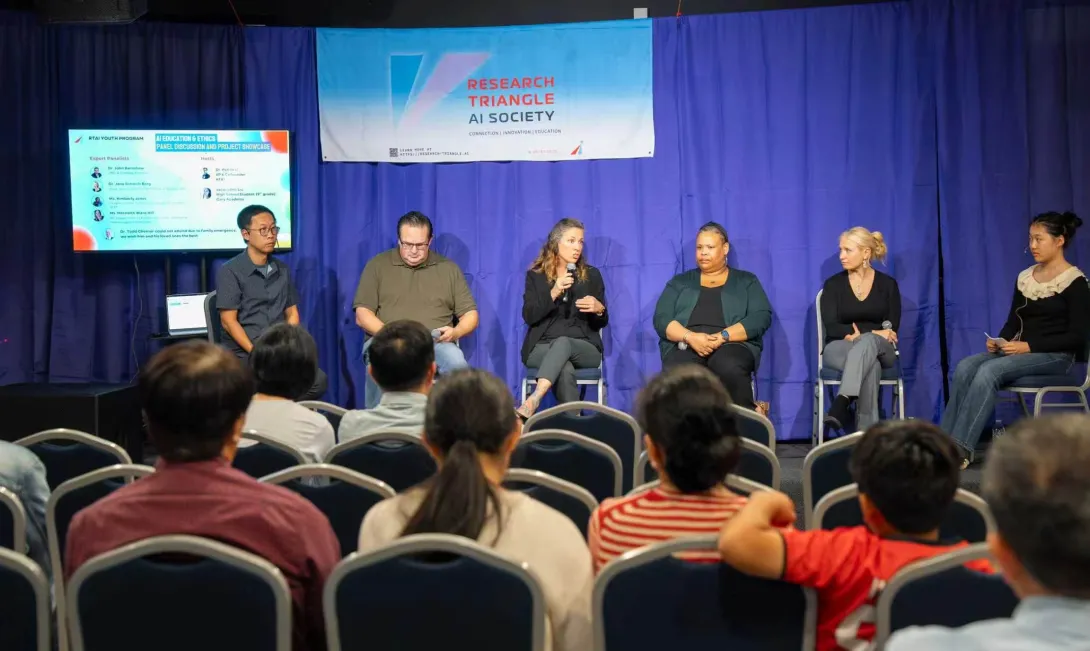
Highlights from the RTAI AI Education & Ethics Panel Discussion
Event date: October 10, 2026
As artificial intelligence rapidly transforms how we learn, work, and interact, parents, educators, and students are confronting questions that have no easy answers. How should AI be used in schools? How can we ensure that students continue developing critical thinking, creativity, and independent judgment? And how do we prepare the next generation for a future that even experts cannot confidently predict?
These questions were at the heart of the AI Education & Ethics Panel Discussion, hosted by the Research Triangle AI Society (RTAI) on October 10, 2026, in Durham, North Carolina.
The event brought together four distinguished panelists:
- Dr. John Barnshaw, Adjunct Assistant Professor at UNC-Chapel Hill and senior leader at College Promise
- Dr. Jana Schaich Borg, neuroscientist and Moral AI researcher at Duke University
- Kimberly Jones, Chapel Hill High School educator and 2023 North Carolina Teacher of the Year
- Meredith Ward Hill, Emerging Technologies Consultant at the North Carolina Department of Public Instruction (NCDPI)
The discussion was moderated by Dr. Henan Li, RTAI Vice President and Co-founder, and Jacqueline Liu, a ninth-grade student at Cary Academy, bringing together the perspectives of parents, educators, researchers, policymakers, and students.
Throughout the conversation, a central theme emerged: AI offers extraordinary opportunities for education, but the ultimate goal must remain developing capable, thoughtful, creative, and resilient human beings.
Rethinking Learning and Assessment in the Age of AI
The discussion opened with a fundamental question: How has AI changed the way we think about learning?
Dr. Barnshaw observed that traditional assessments are becoming less reliable indicators of student understanding. When AI can generate polished essays, solve problems, and prepare detailed outlines, the quality of a completed assignment may reveal little about what a student actually knows.
Meredith Ward Hill expanded on this point, suggesting that educators must shift their attention from final products toward making the learning process visible. Classroom discussions, presentations, demonstrations, and portfolios can help teachers better understand students' reasoning and progress.
Kimberly Jones shared how she has adapted her own classroom practices. Rather than assigning all work to be completed outside the classroom, she increasingly emphasizes in-class activities where she can observe students thinking and working through challenges.
She also described a constructive role for AI: students first develop their own ideas, then use AI to obtain feedback, identify weaknesses, and generate questions that help them improve. The AI assists the thinking process rather than completing the assignment.
Dr. Schaich Borg emphasized the importance of productive struggle. Deep learning often emerges from wrestling with difficult problems, making mistakes, and discovering solutions. AI can support this process, but when it removes the struggle entirely, it may also remove valuable opportunities for intellectual development.
The panelists agreed that education must increasingly distinguish between producing impressive work and genuinely understanding the subject matter.
The Changing Role of Teachers
AI also challenges the traditional image of teachers as the primary source of knowledge.
Jones argued that teachers' contributions extend far beyond delivering information. Teachers create environments where students develop judgment, explore values, engage with others, and learn to navigate complicated questions.
AI may provide information almost instantly, but knowing what to do with that information requires human understanding and experience.
Barnshaw similarly emphasized the value of educators as mentors who help students develop abilities that may eventually exceed their teachers' own expertise.
The discussion suggested that AI need not diminish the importance of teachers. Instead, it may make their roles as mentors, facilitators, and guides more essential than ever.
When Should Children Begin Using AI?
One of the most practical discussions concerned age-appropriate AI use.
Ward Hill described North Carolina's approach to AI literacy, which emphasizes progressively greater engagement as students mature.
For elementary school students, the recommended focus is learning about AI—what it is, how it works, and why its answers cannot always be trusted—before directly interacting with AI systems.
For middle school students, the emphasis shifts toward carefully structured, teacher-supervised interactions. By high school, students can gradually develop greater independence while learning to evaluate accuracy, bias, privacy, and appropriate use.
Ward Hill also introduced NCDPI's AI-use continuum, a framework that allows educators to communicate expectations for individual assignments, ranging from AI-free work to open-ended AI exploration.
She discussed recent North Carolina legislation concerning teacher AI literacy training and district-level AI policies, highlighting the importance of preparing educators alongside students.
Dr. Schaich Borg expressed particular caution about general-purpose AI chatbots for younger children. She distinguished these systems from purpose-built educational applications, such as adaptive learning tools, that may support particular learning goals without encouraging students to outsource their thinking.
However, Jacqueline Liu offered an important student perspective: children develop at different rates, and age alone cannot determine readiness. Parents and teachers must understand the needs, abilities, and maturity of individual students.
The conversation highlighted the importance of balancing appropriate safeguards with opportunities to develop AI literacy.
Preserving Creativity, Identity, and Equity
The panel also examined how AI might influence students' creativity and sense of identity.
Jones raised concerns about AI-generated materials that fail to reflect the diversity of students' experiences and backgrounds. When students rely heavily on AI-generated writing or imagery, their unique perspectives may be replaced by standardized outputs that do not represent who they are.
She encouraged students to preserve their authentic voices and bring their own experiences into their work.
Jones also examined AI's complicated relationship with educational equity. While AI tools could help students who lack access to expensive resources or individualized assistance, students who already enjoy greater advantages may also be better positioned to benefit from them.
Consequently, simply providing access to AI does not automatically eliminate existing inequalities.
Schaich Borg approached the issue from the perspective of cognitive development and human agency. She discussed the potential risks of cognitive offloading—relying on AI to perform intellectual tasks that students would otherwise work through themselves.
She also described research exploring whether students could benefit from greater visibility into their own AI usage, helping them understand when AI supports learning and when it may undermine independent thinking. Such approaches remain exploratory, and their educational effectiveness has not yet been established.
These perspectives underscored a common concern: students should remain the authors of their own ideas and decisions, even when using powerful AI tools.
Preparing Students for an Unpredictable Job Market
The discussion then turned toward one of the biggest concerns facing students and families: how should young people prepare for careers in an AI-driven economy?
Jacqueline asked how students should evaluate college majors and career forecasts when AI may significantly change future employment opportunities.
Barnshaw cautioned against treating predictions about AI-driven job displacement as certainties. He recommended emphasizing communication, social skills, critical thinking, and complex problem-solving capabilities.
Ward Hill reinforced this perspective by referring to workforce research identifying growing demand for analytical thinking, creativity, collaboration, adaptability, and technological literacy.
Jones highlighted the enduring value of humanities education. Her own experience demonstrated how reading, writing, cultural understanding, and curiosity develop the ability to adapt to unfamiliar situations.
Schaich Borg challenged the assumption that successful careers will follow predictable, linear paths. Rather than focusing exclusively on a particular major or profession, students should develop the resilience and confidence to change direction when circumstances change.
The underlying message was clear: we may not know which jobs will dominate the future, but we can help students develop the ability to learn, adapt, communicate, and solve new problems.
Mental Health, Human Relationships, and Resilience
The conversation extended beyond academics to the broader development of children and young adults.
Schaich Borg emphasized that emotional resilience and mental health are essential to navigating uncertainty. She noted the importance of meaningful social relationships and discussed how communities, including faith communities, can foster belonging and a sense of purpose.
Jones expressed concern about excessive screen time and the declining opportunities for students to interact face-to-face. She encouraged young people to value friendships, conversations, extracurricular activities, and the everyday experiences that shape adolescence.
During the audience discussion, a parent raised an especially thought-provoking question: if traditional parenting emphasizes early academic achievement, how should parents instead develop curiosity, resilience, and adaptability?
The panelists offered complementary perspectives.
Jones emphasized reading, literacy, sports, and shared experiences as ways children develop empathy, perseverance, and social skills.
Jacqueline suggested that helping children understand why learning matters and develop their own motivation may be more valuable than accelerating technical instruction.
Schaich Borg emphasized creating opportunities for authentic human interaction, including unstructured time with family and friends.
Ward Hill reminded parents that foundational knowledge—reading, mathematics, science, values, and community—remains critically important, even as technology evolves.
The discussion suggested that many traditional elements of healthy childhood development may become more valuable, not less, in the AI era.
Giving Students a Voice
A particularly meaningful aspect of the event was the active participation of a student co-moderator.
Jacqueline repeatedly asked how students could participate in decisions about AI policies and classroom expectations that directly affect them.
Ward Hill described efforts to incorporate student perspectives into state-level policy development, while other panelists emphasized that educational institutions must listen more closely to young people.
Students are experiencing a transformation in education that previous generations did not face during their own childhoods. Their perspectives are therefore essential to developing workable and responsible approaches.
The discussion reinforced a simple principle: students should not merely be subjects of AI education policies; they should help shape them.
Questions That Remain Unanswered
Audience participation introduced several additional challenges.
How can schools and institutions adapt when organizational structures change much more slowly than technology? Barnshaw discussed the difficulty of redesigning systems originally built for different conditions, while Jones emphasized including more diverse voices in institutional decision-making.
Another audience member highlighted the importance of professional expertise in recognizing AI's limitations. This led Schaich Borg to raise a particularly challenging question: if future students increasingly rely on AI, will they still develop the deep expertise necessary to evaluate and correct it?
No definitive answer emerged.
Indeed, the panelists repeatedly acknowledged that the long-term educational consequences of generative AI remain insufficiently understood. More research, experimentation, and collaboration among educators, researchers, parents, and students will be necessary.
Moving Forward Together
The discussion offered neither an unconditional endorsement of AI in education nor a call to reject it.
Instead, it presented a more thoughtful perspective: AI is a powerful and rapidly evolving tool, but its educational value depends on how it influences human learning and development.
The goal should not simply be helping students complete assignments faster or achieve higher grades. It should be developing independent thinkers who can exercise judgment, ask meaningful questions, learn from difficulties, collaborate with others, and adapt to an uncertain future.
For parents, educators, and students, there is no single formula. The most promising path involves remaining curious, exercising caution where appropriate, learning through experience, and keeping human development at the center of educational decisions.
The future of education is not simply about what AI can do for students. It is about what students can become with AI—and what essential human abilities we must help them preserve and strengthen.
RTAI sincerely thanks our distinguished panelists, moderators, audience members, volunteers, and venue hosts for making this meaningful community conversation possible.
As a nonprofit dedicated to promoting AI understanding, education, responsible adoption, and collaboration, RTAI looks forward to continuing these important conversations and helping our community navigate the opportunities and challenges of the AI era.