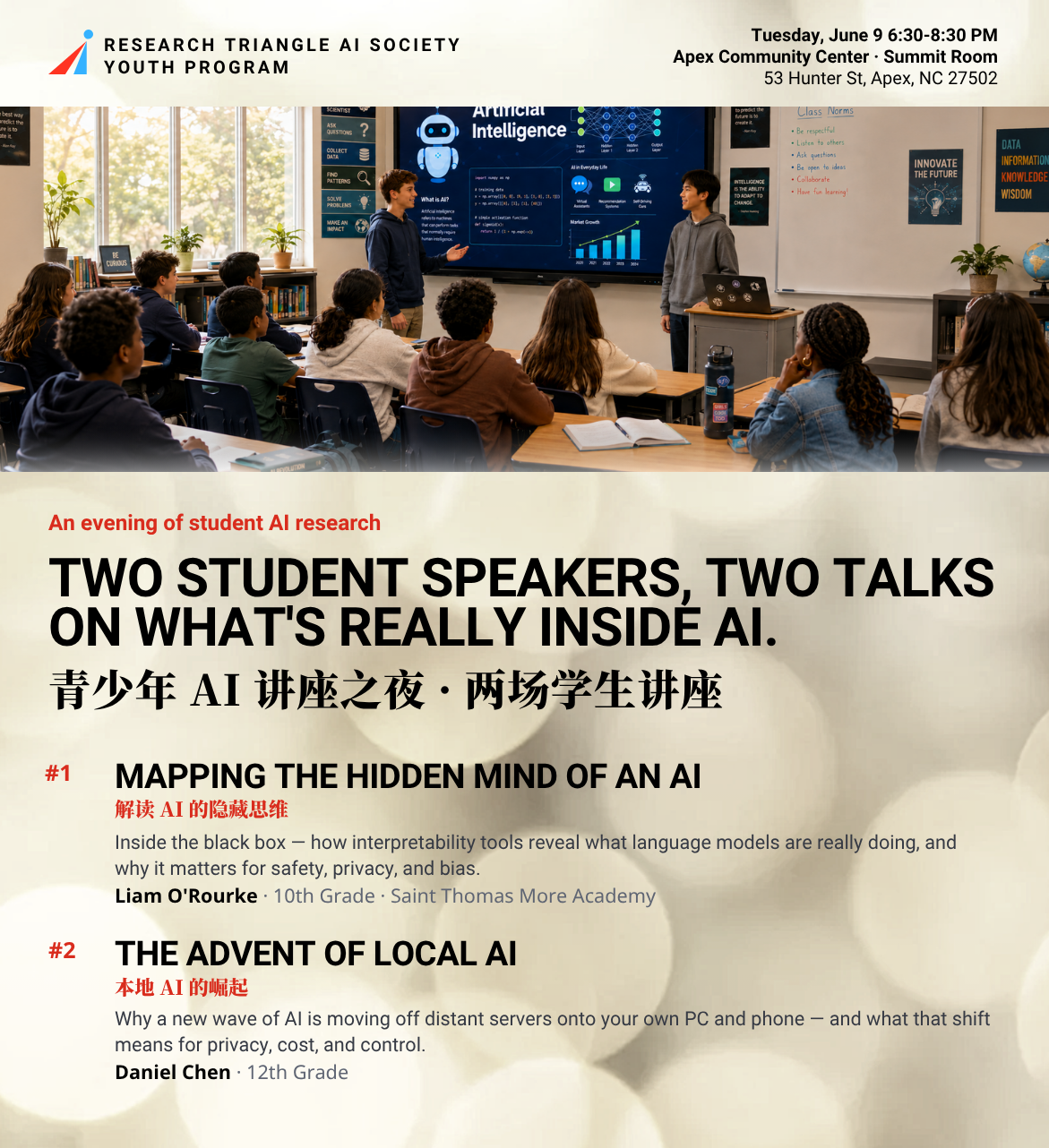
Join the RTAI Youth Program for an evening of student AI research featuring two talks on AI interpretability, privacy, safety, and the rise of local AI.
- First speech: Mapping the Hidden Mind of an AI.
Summary: Cover the basics of how LLMs work and introduce the 'black box' problem, and some examples (such as privacy risks, biases, and misalignment) before getting into interpretability methods like linear probes, SAEs, and the new natural language methods, with practical and cool examples of each from his own research and others. The main focus will be why interpretability matters for AI safety, privacy, bias, and understanding model's behavior.
Speaker: Liam O’Rourke (10th grade)
Bio: I’m a 15-year-old interested in AI interpretability, privacy, and safety. I write about my independent AI research on Substack, where I’ve documented building and training small Transformer language models from scratch, tested chain-of-thought reasoning on math, and explored model internals. I’m currently working on AI privacy research and tools focused on protecting personal information when it's important.
- Second speech: The Advent of Local AI
Summary: Many people think of LLMs as running on servers hosted by Anthropic, Google, or OpenAI in a faraway location. However, there's been a recent upsurge of running LLMs locally (on a PC or smartphone), which have benefits in customizability, privacy, and resource use. For instance, imagine a language model that could provide wilderness survival tips while off the grid. Or, imagine a multimodal language model that alerts you of package thieves without sending the faces of friends and family to a server that could be hacked. This session will cover the potential for this new breed of AI, and how to choose between the vast swaths of options.
Speaker: Daniel Chen (12th grade)
Bio: I'm an 18-year old interested in the way AI progress is measured and built upon in the modern age. I've cofounded a currently-WIP startup that uses AI to scan for allergens in online products. So far, I've been researching the applications of AI models that are run in smaller, less-powerful devices like PCs and smartphones, and how they compare to the established models made by Anthropic, OpenAI, and google. I'm personally excited at the benefits they provide in terms of resource use, privacy, and more. I've also been researching the way AI benchmarks work, and their reliability in comparing the capabilities of similar models from different companies.